
Home Electrical Myths

Household Electrical Misinformation

Larry, buster of home electrical myths

Myths tend to have an element of truth but are otherwise false, incomplete, or misleading. If I tried to cite and quote the sources containing various home electrical myths, there would be no end of it. It will be more constructive for me to give examples of the kinds of untruths infecting our culture and the media, and to encourage think-for-themselfers to educate themselves more in my website and other sources.


Some Specific Myths
Myths From a Sloppy Use of Terms
Myths From Incomplete Advice
Statistical Myths
A Safety Propaganda Conference
 

Some Specific Home Electrical Myths

People need to be more aware of whether they are overloading circuits. If you never want a breaker to trip, you might be able to watch your usage carefully enough to prevent that. But normal people, who inadvertently trip breakers (whether weekly or once in five years), are not doing a no-no. The very tripping of breakers is what keeps everyone from ever truly overloading any circuits. So you don't have to wonder or worry. I think this myth arose from a warning not to overload extension cords, but even these will get too hot more from damage or poor connections than from their watt-rating being exceeded.

A ground-fault interrupter (GFCI) is only supposed to trip when a person is getting shocked. Well, their purpose is to prevent or stop electrocutions of people. But they are too stupid to know the difference between a person getting shocked and a wire or clot of dirt getting "shocked." Their design only tells them to trip for ground-faults of any kind (within a certain milliamp range). See GFIs.

A GFCI receptacle will trip off if you overload it (run too many watts). This is not true at all. Only the circuit breaker in your electrical panel cares about the amount of load things are using. A GFCI is not at all sensitive to that, but it is very sensitive to electrical leaks away from the path that loads (running things) use.

Old wires can go bad in the wall. So can new wires if they are damaged. Wires in walls do not deteriorate much over time. Damage from rodents is quite rare compared to the problems that easily happen at the accessible electrical boxes that hold your receptacles, switches, lights, and connections.

After a wirenut is twisted onto wires, the wirenut and wires need to be wrapped with electrical tape. Wrapping with electrical tape was needed back when connections were soldered and then needed insulation. Tape over a wirenut would make sense if you didn't do the wirenut right. For instance, if copper wire were left visible. I have heard it said that tape on a wirenut is because the normal vibrations in a house (doors slamming) will loosen a wirenut over time. I doubt anyone has documented this. Everything in my experience says that the wirenut connections that give out were poorly done from the start. Then some oxidation and heat over time put the contact of that barely-touching wire in the wirenut over the edge.

Flipping a breaker off and on will reset it if it was tripped. Well, maybe. Of course, it won't reset if there is a short circuit going on. But even if the tripping was a one-time thing, flipping may not be effective. The word "flip" is too flippant. There needs to be a firmness, pressing the circuit breaker handle strongly to OFF first, then strongly ON. See Resetting.

A breaker that will not reset is a bad breaker. Is a watchdog that barks suddenly in the night a bad dog? Remember, the procedure for resetting is not just pushing the handle ON (see the myth we just finished). If the breaker trips within five seconds of being properly reset, it is almost always responding, as it should, to an electrical condition, almost never tripping from a mechanical defect. Also see whether an Outage was even caused by a tripped breaker.

To dispel various myths related to energy consumption in a home by various appliances and lights, see Michael Bluejay.

I also attack misconceptions about the electrical troubleshooting process in my Tips and at HOME.


Electrical Myths From a Sloppy Use of Terms

There are "false impression" myths. One source of these is the careless or ignorant use of terms. For instance, too many internet forums and websites tell people that they may have a "bad ground" or a "short." Among neighbors who don't know what they are doing anyway, throwing words around to speculate on an unfamiliar problem is forgiveable. But when these are put in writing in front of hundreds of people, they perpetuate confusion. My Glossary is a good place to clear these up. I have also tried to take a shot at this in my article, "Electrical as a Second Language."


Home Electrical Myths From Incomplete Advice

I know from experience that it is difficult to be thorough enough in giving electrical advice remotely. The circumstances surrounding a troubleshooting or installation project can make a difference in how it should be handled, and it is almost impossible to address all the possibilities without being there in person, case by case. I have found refuge by using qualifications, like "in general," "usually," and "in most cases." I feel this is better than misleading people with simple-seeming exactness. The result of many "simple step-by-step" instructions is a kind of myth I will call the mini-myth.

For instance, one website describes how to connect wires to a receptacle and it talks about which wire color to put under which color of screw on the receptacle. It even shows photos. That's simple. But what if...? What if the receptacle you bought has no screws? What if there is an odd-colored wire to connect? What if the installer doesn't already know that "putting" a wire under a screw is done by stripping a certain amount of insulation off, curling the end of the wire clockwise, and tightening the screw snugly? I admit, I'm glad I don't try to advise about installation projects on my website. But I don't envy the homeowner who is so often left saying, "What about... ME?" Some mini-myths that could come from the example I have just given are as follows:
  1. Connecting all the wires of an outlet box to the receptacle's screws is the only proper way to install a receptacle. (There are other ways, sometimes better and sometimes necessary.)
  2. All the white wires in an (20-year) old outlet box should connect to the screws designated for white wires. (In some cases, not true.)
  3. If an outlet box has three blacks and three whites, the third wires can be put under one of the two screws already holding wires. (Not proper with most receptacles.)

Statistical Myths, Like 'Danger: Risk of...'

Someone said, "There are three kinds of lies: lies, damned lies, and statistics." Raw data itself can be forged, so it should sometimes be questioned. More often, the interpretation of a statistic needs a healthy dose of doubt. The generic warning, "Danger: risk of fire, shock, or fatal injury" may (or may not) be based on a statistic somewhere. Even so, such a warning might as accurately be given about every action we take or product we use. Will it help, then, to quantify a risk -- ".00003% chance of causing a structural fire with over $10,000 damage," for example? Well, in many cases this might help us realize how remote the dangers really are. See What is an electrical fire?.

The terms "risk of" and "chance of" (should) come from statistical averages. As such, they do not take individual people into account. For instance, the "risk of injury" to a foolhardy, headstrong, uninformed person in their use of a tool is much greater than to someone else. For all we know, the number of injuries (and therefore the risk) to "responsible" people might be zero for a particular product. For the safety industry, it will be enough that a few injuries or deaths have been associated with electrical appliances or wires in general; a generic warning is then supposed to minimize lawsuits. It is with all this in mind that I am calling "Risk of Fire or Injury" a myth. At one time, before dangerous products were tested and banned outright, these warnings would have had more meaning and truth to them. By now, many warnings are so automatic and widespread as to be meaningless, untrue, or even counter-productive (as when people really need a special warning, not more cries of "Wolf, Wolf!"). See also My safety opinions.
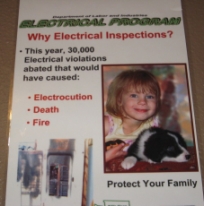

A Case of Electrical Safety Propaganda

In an effort to counteract widespread misinformation, I am taking here one example of home electrical safety myths to show their inaccuracy and their propagandistic nature. If anyone can show me in detail how I am mistaken, I am glad to listen. I undertake this as a matter of freedom of the press. The media (the press) as it is, is barely free, being monopolized by corporate and bureaucratic (governmental) self-interests. But we have the internet, for what it's worth. I would be interested to hear your comments about these electrical safety myths.

I am happy for the public to be made aware of how their homes work and the problems that can develop. I am even OK with appealing to them to alter their habits or have improvements made. But to sell this (and to train others to do so) without consistent regard for the truth does not speak well of these people who have clothed themselves in the nobility of "saving lives."

Below I comment in bold-face type on the statements of a typical safety document. It is from a 2005 conference that can be found at Electrical Safety Foundation International. Within the network of "safety professionals," which the document gives you a taste of, my thoughts would be not be at all politically correct. If there is such a thing as propaganda, it does not appreciate someone pointing out ways it is playing loose with the truth. I am afraid I may be too kind in calling these electrical safety "myths," as if they were harmless silliness.

The entire document (without its references) is shown below.


Residential Wiring Issues: Concerns for Fatalities, Personal Injuries, and Loss of Property
Joyce Rasdall, Ph.D., Associate Professor
Family and Consumer Sciences Department, Ball State University, Muncie, IN
Education Presentation, Annual Household Equipment Technical Conference
General Electric Appliance Park, Louisville, KY; Oct. 26-28, 2005

Abstract.

Aging residential wiring is a major issue as the number of housing units over age 40 increases, historic preservation and restoration increases, and old wiring falls further behind with regard to improvements in the National Electric Code. Corroded wiring at connections only and arcing at poor connections behind faceplates of outlets and switches and in light fixtures are a few of the causes of 40,000 fires annually from poor wiring and poor cord use and overlamping, etc., often in older homes . This annually results in 350 fatalities, 1,400 personal injuries, and upwards of $1 billion of property losses, not to mention inconveniences and frustrations (Larder, p. 1, 2004). The U.S. Consumer Product Safety Commission continues to study these issues and to report statistics regarding this growing issue. Residential technology and consumer specialists are increasingly challenged by whom? by the facts themselves? to participate in a national campaign to deal with this issue.

A New National Problem: Aging Residential Wiring

Electrical safety issues are myriad, covering a variety of consumer products and consumer behavioral issues. In this paper the problem of aging house wiring is the electrical safety focus. Aging wiring is referred to by technical specialists as 20, 30, 40, 50, or 60 years old, depending on the respective wiring specialist.

"According to the National Science and Technology Council's Wire System Safety Interagency Working Group report issued in 2000, the aging of electrical wiring systems is a national safety issue" (Lardear, p. 1, 2004). Currently, half of residences in the United States are 50 years old or older. These wiring systems are likely not adequate for the increasing power demands that consumers place on the systems." The wiring systems themselves may be inadequate in two ways. 1.) the number of circuits available in the original equipment or the amperage capacity OF THE MAIN SERVICE will not accommodate new desires, or 2.) the connections have not held up. Other "inadequacies" only amount to attempts that were made over the life of the house to meet desires without the proper upgradings that would have been called for even at the time (not by later codes as such). Among these adjustments are unprofessional electrical alterations and abuse by consumers (e.g., overlamping, overfusing). The effect of these accumulated defects does make some components of an electrical system unreliable and occasionally dangerous, but the "aged wiring" itself (the wires themselves) is only dangerous (and in that sense inadequate) in certain cases, where its insulation has actually lost integrity as insulation. The generalization that an older house is a less safe house has some truth to it, and not just in the electrical arena. But mounting a concerted campaign for rewiring old homes on the basis of this generalization (and on the statistics that support it) is a political and economic move, however cloaked in altruism (saving lives) it may be.…As their quality and safety deteriorate over time, potential hazards posed by aging residential wiring systems can be unseen or just casually neglected by homeowners or renters." Approximately 41,500 residential fires involving electrical wiring systems if cords, fixtures, and appliances are included annually result in 1,400 injuries and 350 deaths and damage estimates totaling $650 million to $1billion annually in the United States (Lardear, p. 1, 2004).

Unintentional Residential Structural Fire Statistics

Twelve percent of annual unintentional residential structural fires are "attributable to electrical distribution system components (e.g. wiring, lighting, etc.)." These fires result in "8% of the total deaths and 7% of the total injuries" (Miller, Smith, & Greene, p. 1, 2003). Residential structural fire sources and their annual consequences in the United States are listed below:

Table 1
Annual unintended residential structural fires and their consequences in the United States
Electrical item No. of unintentional fires Civilian deaths Civilians injuries Property loss (millions)
Installed wiring 14,100 30 210 260.1
Cord, plug 6,700 80 350 140.7
Receptacle, switch 3,300 10 50 60.6
Lighting 8,500 20 310 127.0
Panel board, meter, transformer 3,300 <20 <40 48.4
Other 3,900 20 130 97.1
Total elec. Distribution system 39,800 180 1,090 $733.9

These losses drive up insurances rates, and the costs of fire protection in communities no, they are responsible for existing rates and costs, and endanger firemen’s lives.

Residential technology educators understand the differences between conductors and insulators, however typical homeowners and students do not typically grasp the principles and consequences involved. Most homeowners and students flip a light switch on or off, casually plug in new electrical appliances they purchase, and if there is no open outlet, they add an extension cord or power strip. Furthermore, "electrical wiring systems that power the conveniences of modern life are hidden in walls and in panel boxes in basements. They are out of sight and out of mind. But that does not mean they are not overloaded and under severe stress" Most of them are not overloaded or under severe stress. Overloading of the in-wall wiring is only possible if the amperage of a fuse or breaker has been altered. Likewise, if there can be said to be stress, it would be at poorly installed connection points, not connections as such and certainly not on the wires themselves (Lardear, p. 1, 2004).

Residences Wired in the 1960s or Earlier

According to the United States Consumer Product Safety Commission, homes over 40 years of age are the greater risk, "but newer ones can have dangers of unacceptable wiring practices and environmental stresses on their wiring" (CPSC, 2005). Residential wiring systems installed in new or existing houses during the 1960s and earlier are almost but not quite? surely at the end of their functional design life. "These products are all? showing some kind of deficiency after 50 or 60 years of service" (Lardear, p. 1, 2004). The housewiring poses hidden but real dangers. "According to the United States Census Bureau's 1999 Annual Housing Survey, there are 70 million homes (or 71% of all housing units) that are at least 20 years old…and of course they aren't getting any younger. In some respects, just by making a casual observation of how old the things look? casual observation of what? of older houses, you can understand why these fires are continuing to occur" (Lardear, p. 1, 2004).

In general, annual residential fires are going down because of better electrical codes, smoke alarms, and fire suppression systems. Thus, homes constructed today do not "face quite the same problems as the majority of the 100 million existing homes in the United States" (Lardear, p.1, 2004). Unfortunately, however, electrical wiring fires sustained by older residences that are especially vulnerable to the issues of aging wiring and overloaded electrical circuits, are not parallel to this downward trend.

Bill King, engineer at the U.S. Consumer Product Safety Commission (CPSC, 2004), indicates that if safety proponents do not deal with the issue of older residences and the (inherent) aging wiring systems, then the fire, fatality, injuries, and property losses have great potential for catastrophe this must mean "they could become more catastrophic". Homeowners generally upgrade construction components including roofs, windows, furnaces, and even electrical circuit breaker boxes or fusepanels. However, the remainder of the electrical wiring system is out of sight and unfortunately out of mind all too often. Wiring concealed in walls and their branch circuits no, the wiring is the branch circuits are typically neglected and hardly ever are replaced (Lardear, p. 1, 2004).

Primary Residential Wiring Safety Issues

The growing problems related to aging residential wiring systems are due to the following parameters:

1. Cumulative effects of a variety of environmental stresses and the wear and tear of daily electrical uses impact life expectancy of residential wiring. The severity of aging of wiring depends on a variety of factors.

A. Degradation of conductors increases with age.

a. Oxidation/corrosion films can cover conductors, especially at connections. which is the only place it matters

b. Excess heat from overlamped light fixtures causes brittle conductors. So the overlamping, not age, is the issue; of course, once overlamped, a fixture is then compromised

c. Conductor technology had little or no innovation during the last 30 years. The most recent major innovation in residential wiring occurred in 1985 when "the required maximum temperature rating of nonmetallic cable was increased to 90degrees C while keeping the ampacity to 60 degrees C," resulting in an effective practice effective practice of what? Rather than require light fixtures to be designed to produce less heat, the ability of the new 1985 wires to stand up to the heat (even without overlamping) let fixtures remain hot. (Lardear, p. 1, 2004).

d. Conductor connections can loosen or even disconnect with time, thus setting up a situation for sparking/arcing if electrical current is to flow when the consumer turns on a switch. This is true; it is why electrical boxes have been required for over eighty years, and these boxes almost always contain the sparks and heat generated. "Sometimes switches can come loose from the wall, and the movement of the wiring back and forth can break connections, damage insulation, or make bare wires touch metal. Any one of these can cause a fire, "can"? none of the stated possibilities is at all likely from a switch being loose, and a fire resulting merely from them is even less likely" (USCPSC, 2004).

e. Connections in electrical outlets, switches, light fixtures, and the like can loosen due to a variety of reasons.

     i. Expansion and contraction due to temperature changes seasonally and daily; then why do most connections not have trouble? I don't think anyone has studied this, but my experience is that most connections that go bad do so from poor installation.
    ii. Vibrations from trains, sonic booms from jet aircraft, other noisy vehicles, high decibel level music/radio equipment, and thunder; does anyone know how well documented any of this is? I have only heard it as hearsay and have seen no evidence of it myself.
    iii. Wind only outdoors and air pressure changes really? are also causes; and/or
    iv. The frequency and or unnecessary use of the switch this might wear the switch out but would not loosen its connections.
B. Deterioration of insulation occurs over time.

a. Heat from overlamped light fixtures True and other installations heavily loaded electrically well, with extension cords this can be, but the insulation of installed wires were all tested and UL-approved to stand up to any legal load; therefore "heavy" loading should never be an issue with the original installation as long as connections are tight, and light cause deterioration and accelerate loss of plasticizer in insulation (Lardear, 2005).

b. Dry locations lead to loss of the plasticizer in PVC insulation. Drying is dependent on length of time and high temperature factors as well (Lardear, 2005).

c. Water absorption into insulation in wet locations this would be wire damage from structural events happening to the home; normal aging does not include water reduces its insulative strength(Lardear, 2005).

d. Rodents and other creatures can damage insulation over the years this again is not normal "aging."

2. If older wiring during add-on wiring jobs is disturbed then safety risks result from cracking brittle insulation An interesting statement. I agree that actually cracking the brittle insulation creates much more danger than if it is left alone. But to listen to warning statements here about the insulation being in poor condition, you would think that that, in itself, was quite dangerous. I would say that it is in fact mainly when brittle wires are disturbed that there is any real problem. Most often this is not a hazard in a concealed place, then, but at the very place the person manipulating the wires can easily notice the bad condition. In fact, some electricians operate with a policy that 30-year-old wiring be replaced because assessing how badly aging has damaged the wiring is difficult at best not difficult if my preceding statement is correct.

3. Increased kilowatt hour use involves most residential consumers owning and using more appliances and lighting than consumers used 40, 50, and 60 years ago. They expect the electrical system to provide adequate electricity for their growing electrical demands. Consumers make this demand operational by adding more circuits (and circuit breakers in blank spots on the breakerpanel, or even another circuit breaker box) and outlets to accommodate their purchases. If an outlet is added to an existing circuit, then the load can easily be more than the wiring was designed to conduct originally -- perhaps decades ago. Not at all true (see my longest opening statement). The only way loads can exceed the capacity of the wire/circuit is if the fuse or breaker has been replaced by one of higher amperage.

4. Peak consumer/residential energy use occurs twice daily (reflected in household energy use patterns from 6 to 8 a.m. and 5 to 8 p.m.), in most U.S. utility systems and consumer households, thus leading to major stress and safety risks on aging wiring systems during these hours. If consumers could level out the peaks, then risks associated with high KWH use could be mediated somewhat. I have never heard this argument before. Who came up with this one? What neighbors are doing puts no stress on one's own electrical system.

5. Small wiring [number 14 American Wire Gauge (AWG)] began to be disallowed by selected local codes during the 1960s in favor of larger 12 AWG. By about 1970, the National Electric Code changed to 12 AWG, thus making the older standard out of date regarding increasing KWHuse and peaks. Unless wiring has been upgraded since 1970, then homes are probably wired with small wiring for common branch circuits. Only in a few jurisdictions is 12 AWG required exclusively. The national code only required 12 AWG for outlets of laundry, kitchen, and eventually bathroom. Yes, the heavier wire will allow more load to run on its circuit, but this only prevents breakers from tripping if that circuit is not available to too many electrical items (which is why Code restricts the 12 AWG circuits that it does require to specific rooms). For instance, if a 12 AWG circuit is run for general use and extends over 800 square feet (as it is allowed to), it may tend to be used up to its maximum amperage (20 amps). A 14 AWG circuit (15 amps capacity), on the other hand, is not allowed to serve more than 600 sq.ft., so it is not that much more likely to invite "over" loading. Where a circuit of a home of any age is not adequate (amp-wise or wattage-wise) for the appliances a person throws at it, an additional circuit should be properly added -- not for safety sake but for the convenience of not having to always be resetting a breaker.

6. Too often unskilled homeowners engage in additions to circuits resulting in installations that do not meet the National Electrical Code (either then or currently) and/or are not inspected by a qualified electrical inspector when finished. Do-it-yourselfers can create serious violations of the code, causing accidents waiting to happen.

7. Too often consumers do not know or do not want to engage in managing aging wiring systems. Maintenance and inspection can be expensive and time-consuming and technically challenging. "As the first step to addressing this issue, the National Fire Protection Association developed NFPA 73, which differs from NFPA 70 by providing requirements for evaluating existing electrical systems" (Lardear, 2004). During the sale of a home, a prospective owner might make certain that the house conforms to NFPA 73 before completing the sale, thus overcoming the most common and risky hazards of an aging wiring system.

8. According to the CPSC (2004), "an estimated 2 million homes and mobile homes were wired with aluminum wire" between 1965 and 1974 in the United States. This wiring used 15 and 20ampere circuits of size 10 AWG or smaller and aluminum wiring in wall outlets, switches, circuit breakers, fuse sockets, and lamp sockets connected to the wiring. "In 1974, the CPSC determined that hazards associated with aluminum wire systems" were "unreasonable risk(s) of injury or death" and filed suit charging two dozen aluminum wire manufacturers. The CPSC indicates that homes wired with aluminum wiring manufactured before 1972 (old technology aluminum wire) are 55 times more likely" to sustain connections that reach Fire Hazard Conditions in contrast to homes with copper wiring. In 1972, manufacturers modified aluminum, including switches and outlets, to enhance performance at connections -- where aluminum wiring problems are -- since aluminum wiring is fine. "...Aluminum expands and contracts three times the rate of copper, likely eventually creating a gap at wiring connections, causing both sparks and oxidation of aluminum ends" (Lardear, 2004). Oxidation fosters electrical resistance and elevated heat levels in the circuit at those connections only, not along the whole circuit. Oxidized aluminum is a poor conductor at those connections only and acts as an insulator in elevated heat environments, a precursor to hazardous arcs and glowing red connections (Electrical Safety Foundation International, 2003).

9. Other results from aging residential wiring systems beyond the safety hazards are the inconveniences, either potential or realized when fire disasters occur. In addition, all kinds of problems that never would progress to a fire or never do, can be quite inconvenient. These can occur in new home too, and include tripping circuit breakers, GFCIs, and AFCIs; blinking lights (disconcerting), occasional outages of part of a circuit, and the ignorance involved in having purchased a home without being informed in detail about what the various components of it are and how they are supposed to work. These matters, too, have psychological and monetary consequences. Psychological costs, personal injuries, fatalities, and property losses are difficult to sustain and involve a variety of monetary and temporal costs with daily living patterns, employment during disasters, and other issues. Inconveniences of aging wiring can involve note that the following are attributed to "aging wiring," whereas they have nothing to do with an aging process or may equally apply to practices in new homes: questionable practices of using extension cords, power strips, and even unplugging a device to plug in another. Aging wiring typically involves few or no exterior outlets and few outlets in kitchen and other task areas.

10. Covering wiring rated for open use is an issue. Covering wiring with attic insulation can cause a fire hazard Is it just me or does "can cause a fire hazard" sound wrong? "Can cause a fire" could be true under a few circumstances; "creates a fire hazard" and "can be a fire hazard" would be other ways to say that too; but this "can cause a fire hazard" is not just excusable jargon or grammatically odd. Like a double negative, it is a "double possible." A "hazard" already is a "can happen," so how is it that something "can" cause a hazard. The phrase wears down our ears' ability to distinguish actuals from possibles. We begin to hear it as if the hazard is a concrete bad thing, whereas the bad thing is a fire in attics and other concealed spaces. If insulation is added to a house, then any wiring or fixtures (recessed ones only) covered with insulation must be certified/rated for such conditions (USCPSC, 2004).

11. Lack of safety improvements over the years that are now required in the National Electric Code include Ground Fault Circuit Interrupters (GFCIs) and Arc Fault Circuit Interrupter (AFCI). Having at least 5 feet between an outlet and a bathtub may be violated in older wiring. -- This is still not required, even of new homes.

Arc faults: a Growing Safety issue

An arc fault is commonly called a spark. An arc fault is "a discharge of electric current across a gap" between electrical conductors. "In a home, arc faults can be years or just seconds in the making. Arc faults can be caused by a variety of factors including loose or improper connections to outlets or switches; cracked wire insulation stemming from age, heat, or corrosion does corrosion crack insulation?; and electrical wire insulation chewed by rodents or punctured by nails." Arcs if sustained are particularly dangerous in walls and ceilings since temperatures of 10,000 degrees F or above can ignite wood easily. The CPSC (2004) estimates, fires starting with electrical distribution systems including lamps, appliances and cords amounts to more than 10 percent of all home fires, partially as long as percentages are being given, is there one for this "partially"? because of arc faults. "Since household fuses and circuit breakers do not respond to early arcing and sparking conditions, in January 2002, the National Electrical Code (1999 NFPA70, Section 210-12), began requiring Arc Fault Circuit Interrupters (AFCIs) for all branch circuits supplying 125V, single phase, 15- and 20-ampere outlets for bedroom circuits in new residential construction" (Lardear, p. 1, 2004). Scorched areas around faceplates and circuit breaker or fuse panels can mean sparking or overloaded no, only if overloading resulted in insulation damage which then resulted in sparks; actual overloading is rare and in itself would not be able to ignite things unless 15-amp wire, say, were loaded to 40 amps or more, inadequate wiring that could ignite paper, fabric fibers, and/or wood nearby (USCPSC, 2004).

Thus, AFCIs and their capacity to identify unique electrical current and voltage characteristics are probably more important for deteriorated aging wiring systems than for new construction... Yes perhaps, but until the longevity of insulation is improved and the fact of wear and tear on some parts of the system (especially fixtures, cords, and receptacles) is eliminated (how could it be!?), AFCIs will be just as important for the homes that are new (now), since they too will deteriorate. AFCIs sense arcs and sparks in wiring at receptacles and switches. AFCIs have capabilities beyond that of fuses and circuit breakers, particularly no, their value (over standard breakers) is equal for exposed and hidden arcs; for deactivating arc faults hidden in walls and ceilings. AFCIs are unique i.e., different from Ground Fault Circuit Interrupters (GFCI) that protect against shock (dangerous overcurrent flow no, not overcurrent at all; they protect from leaks [usually small ones] off of the circuit path). Both GFCIs and AFCIs deactivate a circuit, but each protects a unique cause, dangerous power surges/shorts -- this to characterize GFCIs? incorrect! or arcs and sparks at wiring connections at receptacles and switches respectively.

The CPSC and the National Fire Protection Association have worked together to require arc fault detection devices in new and retrofit construction (USCPSC, September 2000). The 2002 edition of the National Electric Code specifies Arc Fault Circuit Interrupters in bedrooms in order to reduce risks among consumers while sleeping (National Fire Protection Association, 2005). The 2005 edition adds AFCIs to within a few feet of the circuit breaker panel in order to protect from sparks in that vicinity no, Code allows a non-breaker type of AFCI device close to the panel in order to be able to protect a circuit of an older panel which cannot receive any AFCI breakers. Sparks coming from the panel itself would not be sensed at all by an AFCI device near the panel. More AFCI provisions are under consideration for future editions.

Aging Residential Wiring Safety Educational Campaigns

A partnership of the National Fire Protection Association’s (NFPA) Fire Protection Research Foundation with several other groups is a major educational campaign of which this document seems to be a part (Lardear, 2004). In May 2003, the Electrical Safety Foundation International (ESFI) initiated its "Inspect and Protect!" program to spur homeowners to engage a qualified, licensed electrician since forensic electrical engineers are scarce; unfortunately for the consumer, "licensed electricians" are available mostly in the form of contractors, who have a vested interest (conflict of interests) in how they assess the condition of the system to inspect wiring systems in homes 40 years and older, to learn about the potential hazards posed by aluminum wiring systems and to consider installing AFCI technology (Electrical Safety Foundation International, 2003).

Implications for Consumer Educators and Residential Technology Specialists

Encouraging consumers to maintain house wiring, just as a car, furnace, roof, or chimney needs maintenance is critical. Establishing priorities for first and then second maintenance/updates is a functional step (USCPSC, 2004). Asking consumers to check with the respective insurance agent to ascertain if wiring safety improvements qualify the policy holder for a premium reduction is a recommendation.

Aging residential wiring issues pose serious implications to consumer educators and residential technology specialists. How will these professionals/educators deal with this growing problem? Is it a "growing" problem? The awareness of problems has certainly grown, but for the problem itself to have grown would take some statistics. How would this growth be measured? Fire data would have to show that homes of a given age are more prone to fires than homes that age ten years ago were (no data on this that I know of). That would be a growing problem. But to notice that homes as they age are a bit more prone to electrical fires does not tell us that a problem has grown. The biggest way that electrical fire frequency goes down is by new homes replacing old and by old ones being rewired naturally (without a campaign) for many reasons including relative fire hazard. The campaign for rewiring old homes is painted and justified as saving lives, but if campaigners received no economic benefit in the process, there would be no big campaign. Even if only homeowners were paranoid, as they are enough already, about electrical fires, they will not mount (have not mounted) a campaign on their own behalf. Why? Because the evidence they themselves see of the risk is not compelling enough. To not pay for preventing remote possibilities, they are willing to risk doing nothing until something shows itself. Campaigners take the patronizing attitude that such people, not knowing what is good for them, need to have it done for them, with some of those people's (consumer and tax) money ultimately going into the campaigners' pockets. I like to inform people of good electrical-use practices and malfunctions I am seeing, but to tell a given person that they are in imminent danger when I know no such thing is immoral. If I let myself be convinced that they are in such danger, then I will seem to be positively obliged to scare them. But it can still be immoral to have let oneself be convinced, by others, of a great danger, without using ones own judgment. Residential technology educators are challenged to

1. Engage in curriculum upgrades that involve aging house wiring issues,
2. Develop resources and reference list with strategic data i.e. data that supports the campaign (propaganda), not truly educative resources,
3. Develop class learning experiences with speakers and tours focusing on aged wiring issues, and
4. Incorporate student real world projects such as that described below.

Old wiring how old? needs to be abandoned and replaced (!!!). The consequences of not upgrading old wiring any old wiring? without assessment of individual cases? are clear, can be formidable, and need to be addressed among students preparing for careers in Residential Technology and related Family and Consumer Sciences Programs otherwise their careers will not be allowed to advance, am I right?.

Residential Technology Student Project

Experiential learning is enhanced by students in an Interior Design studio 2 course at the sophomore level completing a project with one to five owners or occupants of aging housing, depending on the percentage of the final grade the project represents. Students identify their contacts and use the implications section outlined above to structure their own interview outline. Each student uses the section following for questions and priority issues addressed in this project in order to identify consumers’ real world experiences with this electrical safety issue. A summary of each interview/site is reported separately in outline format by the student. Lastly, an overall summary and analysis is synthesized by each student.

Objectives for the project include How handy, using students to "educate" the public one by one under the guise of a survey. True, the students themselves are gaining propaganda skills too.

1. To investigate current aging residential wiring/electricity use and practices for safety concerns.
2. To discuss aging wiring issues and their consequences with occupants.
3. To examine occupant awareness and understanding of aging wiring recommendations.
4. To summarize findings from occupants in each residence and synthesize recommendations as for best practice and electrical safety of the occupants. Students gain greater insights from on-site, in-person interviews than through only the lecture and class discussion prior to the field experience. Many students are interested in do-it-yourself residential upgrades and restorations and thus through this project they gain increased human capital for decision-making personally and for professional consultations in their future careers I'm not sure I grasp the gist of this jargon. Thus, this project enables students to gain ownership of their careers, rather than only learning on the sidelines.

Questions and Priority Issues for Consumer and Student Consideration

1. List the causes of hazards of aging residential wiring. So the errors in this document will be propagated third-hand to the general public. I'm not saying that no truths will be imparted, just that the public will have no way to distinguish true from false in what they are told.

2. Cite the consequences of aging residential wiring issues. Mainly fire, apparently...Also how about "cite the possible consequences..." instead.

3. What visible evidences are there in and outside the home of aging wiring practices? What is an "aging wiring practice"? Is it an old, outdated wiring practice?

4. What problems do the occupants report regarding dysfunctions of aging wiring? I don't think they will report any problems as being from their "aging" wiring, just from their wiring; and if they report a problem in an area of the home that was recently professionally rewired, will that count as a wiring problem of older homes?

5. What improvements have the occupants made with the aging wiring, if any?
6. What plans and timetable for improvements do the occupants report, if any?
7. What recommendations should we propose among Do-It-Yourselfers?
8. What implications are there for historic preservation, restoration, and retrofits of homes, offices or retail space or other adaptive reuse,
9. When a home constructed prior to 1960 is sold, will the buyer have it electrically inspected by a competent, licensed electrician or inspector?
10.Based on the consumer’s experiences with wiring in an older home, what recommendations does he/she propose if she/he were to move/relocate?
11.Unless the residence is rewired, will it have an electrical inspection as a part of responsible electrical system management? If no, cite reasons; if yes, cite reasons.
12.Will electrical inspection by a competent electrical inspector be completed during initial wiring of a new home or rewiring during home improvements and added on space both for interiors and exteriors?
13.What consequences can be incurred when rooms or homes are redesigned as in the current popularity of shows such as Designers’ Challenge, Design for the Sexes, and Chic Design on the Home and Garden Channel? What recommendations for re-wiring or wiring updates are needed during these television segments?

Summary

Because aging residential wiring is a national issue involving substantial property losses, fatalities, and personal injuries annually, this problem is becoming more critical among relevant professionals, including residential technology educators and consumer specialists. A student learning project was designed to examine aging wiring issues in the field via on-site interviews. This experience builds on the traditional lecture and discussion method and enables residential technology and other FCS students to gain insights in order to build human capital this jargon means what? for personal decision making. Thus, the learning experience is strategic for critical thinking processes And as for critical thinking about the technological propaganda being promoted here, what resources are there? and for building ownership of students’ careers. When electrical safety decisions by other consumers are at stake residential technology students can benefit from the descriptive and analytical processes included in this real world project.


Relation of electricity to fires
HOME

© 2008 Larry Dimock