
Notes Explaining Wiring Connection Diagrams
Explanation of Cables' Lettering:
See the diagrams this page refers to
Show side-scrollable chart for smaller screens.
| Code | Cable | Nickname | White wire |
Black wire |
Red wire |
Examples in Typical Circuit |
|---|---|---|---|---|---|---|
| p | 2- w i r e |
"power" | neutral | hot | -- | between A3 & A4 |
| L | "light/leg" | neutral | switched | -- | between A2 & A1 |
|
| h | "loop" | hot | switched | -- | between B3 & B4 |
|
| x | (3-way) (4-way) |
traveler | traveler | -- | also... | |
| n | 3- w i r e |
(3-way) (4-way) |
hot or switched or traveler. (not neutral) |
hot or switched or traveler |
hot or switched or traveler |
between B2 & C2 also... |
| t | (3-way) (4-way) |
neutral | traveler | traveler | between A7 & B7 |
|
| f | "fed" | neutral | hot | switched | between C3 & D3 or B5 & C5 |
|
| m | "multiple" | hot or neutral |
switched | switched | © 2018 Larry Dimock |
|
| d | "double" | neutral | hot | hot | also... |
Also check this Overview chart with even more cables and boxes, but without the graphics.
NOTES:
- My house electrical wiring diagrams are meant as help in understanding or restoring connections in the existing wiring of a home, but I am sure those who are wiring new circuits will find it helpful too.
- Printing some of the larger images may be difficult; try using the "landscape" orientation.
- The connections shown at present are for one-gang, two-gang, three-gang, and light boxes; for standard receptacles and single-pole and 3-way and 4-way switches; and not for any box with more than one receptacle or a combination of receptacles and switches. For GFCI receptacles, see GFIs, and see 3-ways for 3&4-way switch systems. Not shown here are several variations of a very rare type of 3-way switch system wiring; see Rare 3-ways.
- The wire colors are conventional and are to Code -- at least for most homes built from 1940-1998 (using cables rather than knob-and-tube wiring). The difference for homes built since then is that white wires not used as neutrals are now to be recolored. An "n" cable's wires continue to be quite interchangeable in regard to their factory-colors, but if such a cable runs directly between a leg-end 3-way switch and the light being controlled, its common wire was never, and is never, to be the white, even recolored. This is true of the switched wire of an "h" cable too.
- Ground wires (bare or green) are not shown. If present, typically they are all supposed to be combined with each other and with any single ground wires that are to extend to the devices or fixtures mounted to the box.
- Neutrals are always white, but other whites shown, especially going to switch boxes, can be hot or switched-hot wires. When they could have served either of these functions (hot or switched), I have not always diagrammed both alternatives.
- Where the 2011 or later code (NEC) is in effect, new wiring for switches will usually include a (white) neutral. Therefore, where there is such new wiring, in place of many h-cables in these diagrams, you will find f-cables, whose red will be connected as the h-cable's black had been connected; its black will be connected as the h-cable's white had been connected; and its white will be connected to neutral(s) at the light or receptacle being switched. Unless the switch is electronic, this neutral might not be connected or used at all in the switch box.
- Since red and black wires are allowed to be hot or switched-hot, the convention I have followed in the diagrams (red often being switched) is not the only color scheme possible.
- Electrical wiring connections in one diagram can look identical to those in another, but the functions played by these wires will be different, as indicated by the code letters on the cables shown.
- Also, where there is more than one "L" cable in a box or more than one "p" cable, the diagram will not indicate which one is "incoming" with respect to the box. In any case, the rest will be "outgoing." Sometimes the neutral in a cable whose switched wire is incoming, will be outgoing; or vice versa.
- In connecting to a single-pole switch, it does not matter which of the two terminals receives the constantly hot wire(s) and which receives the wire(s) to be switched.
- In connecting to a 3-way or 4-way switch, it does not matter which terminal of a pair of traveler terminals receives which wire of a pair of traveler wires.
-
In some cases there are other ways of making the connections in a box than I show, but the nature of the connections and the function achieved by each cable are the same. See examples in image:
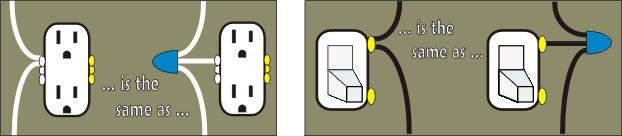
- Where two wires are shown as contacting a single side-screw on a receptacle or switch (as above), this is not to indicate that more than one wire should ever be put under a screw (they shouldn't). It means that connections can be made on the device -- by any combination of screws, back-holes, clamps, and pigtailing with wirenuts (as above) -- all within the capacity of each option.
- The connections shown assume that only one circuit is involved in the wiring. The exception is where a "d" cable is shown.
- Where a cable brings two circuits to a box (a "d" cable), most neutrals of these circuits were supposed to be combined there, not relying on any receptacle for making the connection. The exception is when the neutral that would be interrupted by removing the receptacle was going on to other items of the same circuit that was running this receptacle. I comply with this in the diagrams.
- Where individual house electrical wiring diagrams are labeled with a red number, this tells you that the same diagram is found in the Connections Tutorial, where commentary on it is also given.
- Within each box/cable possibility in the diagrams, ones with an asterisk (*) are less common than others in that same section.
Connections Tutorial
Sitemap of all diagrams